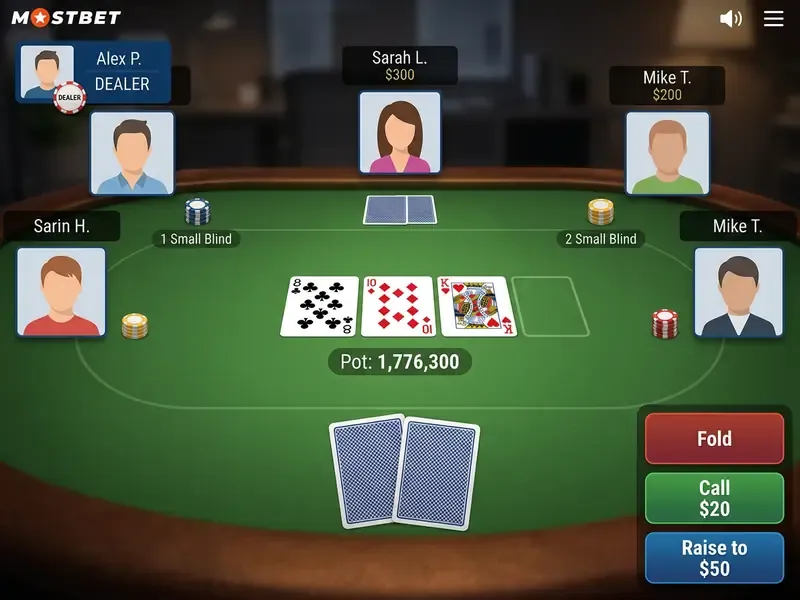
Poker Online: How to Play, Choose Games, and Start for Free
Last updated: June 2026

Last updated: June 2026
"Our editorial mission is to separate gambling myths from real mathematics and sporting discipline. Analysing the iGaming industry for a Bangladesh audience, we see that poker online is first and foremost a game of probability and emotional control — not a random lottery. The path should always begin with free trainers and a full understanding of local legal risks."
Nadia Farzana Haque, Editor-in-Chief, iGaming Bangladesh.
Poker is a skill-based card game where players compete against each other, not the house. This guide walks you from the very first hand ranking to choosing a safe site, practising for free, understanding deposits and bonuses, and sitting down at your first real-money table. If you are based in South Asia, pay special attention to the compliance notes on local payment risks and legal status.
Poker is an intellectual card game built on incomplete information. Victory depends on mathematical calculation, psychological reading, and disciplined bet management. That last part — discipline — is what separates poker from most casino games.
Here is the core difference. In a typical casino game the player faces a built-in house edge, usually somewhere between 0.8% and 1.5%. A poker game works differently. It is a zero-sum contest: poker players compete against each other, and the platform simply charges a fixed commission called rake for organising the table.
"Online poker functions as a complement to the offline market rather than a substitute — digital platforms effectively increase total demand for poker activities." — Empirical research on online/offline poker complementarity (2023).
note

So why do people choose poker online over a live card room? Three reasons come up again and again: global accessibility, non-stop gameplay, and a wide range of stakes. The digital format removes geographical barriers and lets participants join hands from a mobile device at any hour. Around 90% of active poker players now combine live and online formats, which confirms how deeply digital platforms have woven themselves into poker culture — Industry analysis on poker player behaviour (2023).
Worth noting: the difference between free and real-money play is mostly psychological. Playing for virtual chips lets you safely learn the interface. Real-money formats, on the other hand, demand strict bankroll management and awareness of local legal restrictions. We will cover both paths in detail below.
The core distinction between online poker and casino poker comes down to speed, automation, and the absence of face-to-face contact. In the digital environment cards are dealt instantly, the pot is calculated automatically, and decision time is limited by a software timer. No shuffling, no chip-counting delays.
In practical numbers, digital platforms process roughly 60–100 hands per hour at standard tables — and up to 200+ hands on fast-fold (Zoom-style) tables. Compare that with 25–35 hands per hour in a live casino with manual dealing — Behavioural research on online poker environments (2023).
Playing online poker also enables multi-tabling, meaning you can run 4–8 tables simultaneously. That is physically impossible in a brick-and-mortar venue.
What about reads? Players transitioning from live poker to online are forced to replace physical tells with analysis of betting patterns, timing, and chat behaviour — Behavioural research on live-to-online poker transition (2023). On some poker sites, auxiliary HUD programs track opponents' actions, converting what used to be reading body language into mathematical probability. Keep in mind that HUD availability varies by platform; some regulated sites restrict or outright ban third-party tracking software.
One more thing that catches newcomers off guard: the sheer volume of decisions. More hands per hour means more opportunities to learn — but also more chances to make costly mistakes if you are not paying attention.
A question many beginners in Bangladesh ask is how poker compares to sports betting. In sports betting you forecast an external event you cannot influence. A cricket match, a football fixture — you analyse, you predict, but you never touch the ball. In poker you directly manage probabilities, bet sizing, and opponent manipulation throughout every single hand.
Both require analysis. But poker gives the player more control over outcomes, which is why it is classified as a skill game in many jurisdictions. That said, "more control" does not mean "guaranteed profit." Variance is real, and short-term results can swing wildly regardless of skill level.
Basic poker rules come down to two paths to victory: assemble the strongest hand combination at showdown, or force all opponents to fold through aggressive betting. Every poker game takes place at a table with a starting set of chips. The pot — the total chips wagered — is formed from what players commit during several betting rounds.
Before we get into the action, let us define the terms you will see everywhere.
Hand strength in traditional poker is determined by a fixed hierarchy of five-card combinations. The logic is straightforward: the harder a hand is to make, the higher its rank and the better its chances of winning at showdown.
According to standard international rules (World Series of Poker), the ranking from weakest to strongest is:
How rare are the top hands? Statistically, a royal flush appears once in roughly 649,740 hands. A straight flush shows up once in about 72,193 deals. Four of a kind? Once in 4,165. These numbers are not trivia — they are the mathematical backbone of hand rankings. Knowing them helps you gauge how strong your position really is.
If two players hold the same ranking hand at showdown, the highest kicker is used as a tie-breaker. When hands are identical in every respect, the pot is split evenly — what players call a "chopped pot."
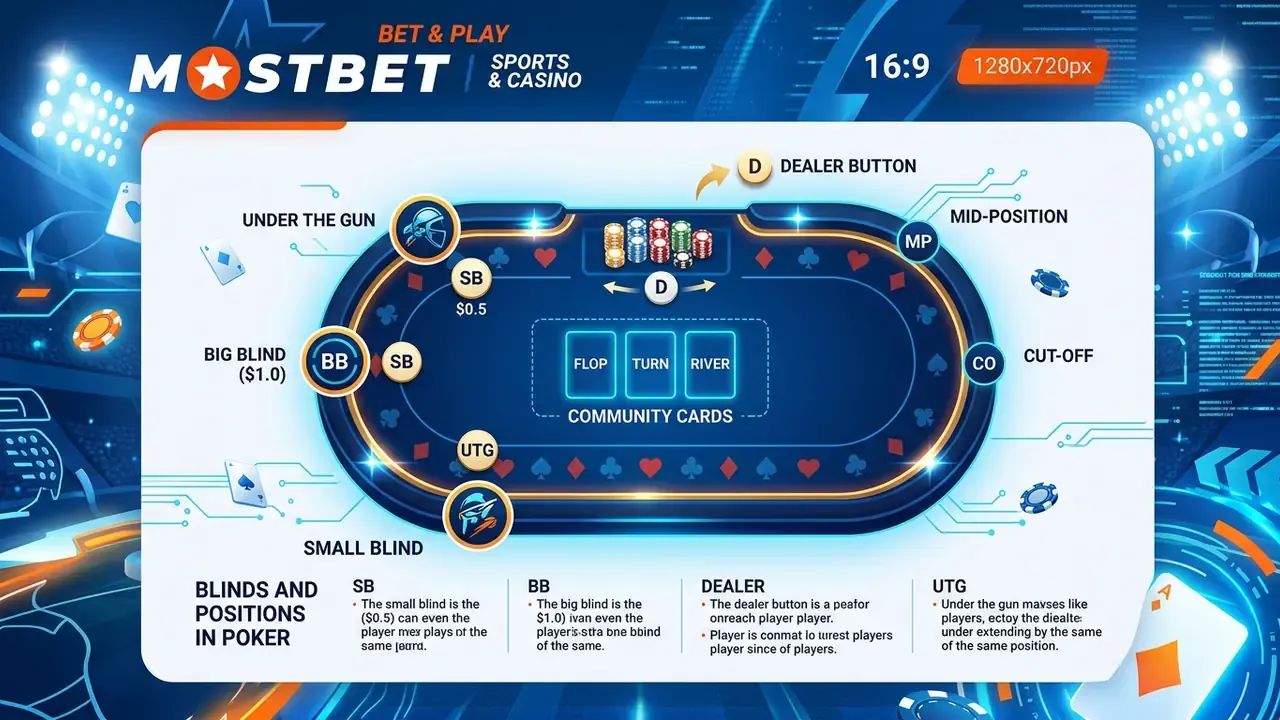
The betting structure is divided into rounds called streets, each accompanied by new community cards. Before any cards are dealt, the Small Blind (SB) and Big Blind (BB) post forced bets — the BB is typically twice the SB. This ensures there is always something worth fighting for in the pot.
Preflop Each player receives two private hole cards face-down. The player to the left of the Big Blind — known as Under The Gun, or UTG — acts first and may fold, call (match the Big Blind), or raise. Action continues clockwise. A standard beginner approach: play a tighter range of hands in early position, sticking to high pocket pairs, AK, and AQ suited.
Flop Three community cards are dealt face-up in the centre of the table. A new betting round begins, starting with the first active player to the left of the dealer. A player who raised preflop will often make a continuation bet (c-bet) on the flop to maintain initiative. This is one of the most common — and most effective — plays in all poker games online.
Turn A fourth community card is revealed. Another betting round follows the same order. In fixed-limit games, bet sizes commonly double at this stage, which is why the turn is sometimes called "the expensive street."
River The fifth and final community card lands on the board. The last betting round takes place. If two or more players remain after the river action, cards are revealed at showdown and the best five-card hand wins the pot.
The difference between limit and no limit determines whether a player can go all-in at once or is restricted to a fixed bet size prescribed by the rules. We will break down these structures in more detail later.
Dozens of variations exist, but the foundation of the industry rests on a few core formats: Texas Hold'em, Omaha, and various Stud/Draw games. The differences lie in game mechanics, the number of pocket cards, and rules for building the final hand. Entry complexity varies too — Hold'em is ideal for beginners, while Omaha demands more advanced mathematics from the start.
Comparison of popular poker games online
| Discipline | Hole Cards | Community Cards | Used for the Hand | Beginner Difficulty |
|---|---|---|---|---|
| Texas Hold'em | 2 | 5 | Best 5 from 7 available | Low |
| Omaha High | 4 | 5 | Exactly 2 hole + 3 community | High |
| 7-Card Stud | 7 (face-up & face-down) | 0 | Best 5 from 7 personal | Medium |
| 5-Card Draw | 5 | 0 | Own cards with exchange option | Minimal |
Texas Hold'em firmly holds the status of the most popular format, capturing roughly 80–90% of worldwide poker traffic on major platforms. Omaha and Seven-Card Stud trail far behind — Industry analysis of poker traffic distribution (2023). The dominance stems from a near-perfect balance between transparent mechanics and limitless strategic depth.
Why do new players gravitate toward Hold'em? The five community cards make the game visual and intuitive. You can see most of the board, which makes it easier to calculate your mathematical odds of winning.
And there is a practical reason too: because of massive demand, operators launch Hold'em tournaments every few minutes, guaranteeing instant seating. You will almost never stare at an empty lobby.
That said, do not mistake "easy to learn" for "easy to master." The strategic depth of Hold'em — or rather, the gap between a beginner and a skilled player — is enormous. That is precisely what makes it compelling.

Omaha and Seven-Card Stud offer a different pace of play and more complex hand-building rules. In standard Omaha a player receives four hole cards and must use exactly two of them, plus exactly three community cards from the board. This increases the density of strong combinations dramatically — single pairs rarely win here, which can be a shock if you are coming from Hold'em.
In 7-Card Stud there are no community cards at all. Players receive seven personal cards (some face-up, some face-down) and must assemble the best five. The key skill becomes mathematical memory — tracking which suits and ranks have already appeared in opponents' exposed cards. It is a slower, more cerebral game.
Some players find it meditative; others find it frustrating. Either way, it rewards patience.
5-Card Draw is perhaps the simplest variant and the one most people picture when they think of "poker" from old movies. You get five cards, you can exchange some of them, and the best hand wins. It is rarely played at serious stakes online, but it remains a solid starting point for absolute beginners who want to understand hand rankings without the complexity of community cards.
Getting started requires a practical checklist: platform review, account creation, payment method and KYC verification, client download, table-selection setup, and finally sitting at your first table. Following this path minimises technical headaches and protects your data.
Your choice of platform should rest on strict analytical criteria, not flashy banners. The best poker sites have stable player traffic — evaluate the peak concurrent online count to make sure the lobby will not be empty during your preferred hours.
Five critical criteria for a beginner:
For readers seeking a curated overview of how editorial standards and compliance principles distinguish a safe educational site from a risky one, our team has analysed 15 platforms and compiled findings in the iGaming platforms section.
notePlatform verification checklist Before you play, verify three safety markers (per iGaming compliance standards):
- A current licence from a gambling regulator (e.g. MGA, UKGC, or a local body).
- An RNG (random number generator) audit by an independent lab — eCOGRA, iTech Labs, or GLI — confirming that cards are dealt randomly.
- Transparent responsible-gambling limits: the ability to self-exclude or cap deposits and session time. No strategy matters if the site cannot guarantee fund safety.
Legal platforms typically support Visa, Mastercard, and crypto transfers (Bitcoin, USDT). Welcome bonuses — often a 100% Deposit Match up to $500–$1,000 — double your first deposit but require wagering (play-through) via rake generation.
Always read the terms. Look for the release rate (how much rake unlocks bonus dollars) and the expiry window. A generous-sounding bonus with a 90-day expiry and a steep rake requirement might be worse than a smaller bonus you can actually clear. Some sites also offer no-deposit bonuses or free tournament tickets, which are ideal for a risk-free start.
Transitioning from signup to gameplay requires completing security procedures. First, the user creates an account and passes mandatory identity verification (KYC). When choosing stakes, a beginner should start at the lowest available tables — typically $0.01/$0.02 blinds. There is no shame in micro-stakes. Honestly, it is where most poker players build their foundation.
After verification is complete, download or launch the browser client, navigate the lobby, filter by game type and stakes, and join your first table. Most modern poker rooms are built with HTML5 and Progressive Web App technology, so you can play directly in a mobile browser without installing anything. That convenience matters — especially if you are testing a platform before committing to it.
The gap between free poker online and the real-money format is enormous. And it lies not in the rules but in player behaviour. Practising in demo mode is perfect for learning the interface, while money-backed play demands strict discipline, awareness of value, and genuine risk management.
Free-format play — poker for virtual chips — is ideally suited for initial skill-building and memorising basic rules. Behavioural neuroscience research shows that playing in an environment free of financial risk gradually trains the brain's decision-making circuits, specifically the regions responsible for assessing consequences under uncertainty, to react faster to mathematical probabilities — Behavioural neuroscience research on poker decision-making (2023).
In plain terms: free practice builds table confidence. You press buttons without panic, clearly understanding who acts next and how betting works. That alone is valuable.
Recommended free social-poker apps for safe practice:
These apps are legal in virtually all jurisdictions, including Bangladesh, because they do not involve real-money wagering. You can download them, play poker for hours, and never worry about legal complications.
When you switch to real stakes — even micro-limits — the entire dynamic shifts. Opponents stop playing junk hands and shoving all-in without reason. Decision-making becomes far more rigorous because every chip represents actual value. Players who transition from free tables to real money demonstrate improved emotional regulation and reduced susceptibility to "tilt," provided they have put in extensive practice in demo mode — Psychological studies on free-to-real-money poker transition (2023).
Here is the catch, though. Free-only practice loses its strategic value if the goal is to learn profitable (+EV) decisions. Why? Because players who never risk real chips develop distorted bluffing patterns. Opponents at free tables call everything, giving you no reliable feedback on bet sizing.
You think your bluff worked because everyone folded — but in reality, you were just playing against people who did not care.
One more consideration worth mentioning: psychiatric comorbidity is particularly prevalent among women with gambling disorder, underscoring the importance of responsible-gambling tools even in free formats — Psychiatric comorbidity research in gambling disorder (2023). Responsible play is not just a legal checkbox. It is a genuine health concern.
Legal Compliance Note iGaming Bangladesh reminds readers: gambling is strictly regulated across jurisdictions. In many South Asian countries, including Bangladesh, real-money play, online casino operations, and sports betting fall under strict legal prohibitions and financial monitoring (Central Bank regulations). Transactions through local mobile wallets such as bKash or Nagad toward unlicensed gambling sites may result in wallet suspension or account blocking. Any participation in real-money games carries a 100% risk of capital loss. Verify the legality of any platform in your country and observe the 18+ age requirement. This information is provided solely for analytical and educational purposes.
warning
Disclaimer: The content of this article is general in nature and does not replace professional legal or financial advice. Participation in real-money gambling may be illegal in your jurisdiction.
disclaimer
Disclaimer: All strategy information is general in nature and does not replace specialist consultation. Any strategy involves the risk of financial loss.
disclaimer
The best poker strategy for a beginner is the Tight-Aggressive (TAG) approach. The idea is simple: play only a limited number of strong starting hands (filtering out weak cards preflop) and bet aggressively when you do enter a pot. The key to a positive win rate is pot control and mathematical discipline — not heroic bluffs.
Correct hand selection determines roughly 80% of early-stage success. That number might seem high, but think about it: if you enter pots with weak cards, no amount of post-flop brilliance will save you consistently. For a TAG style the norm is to enter only 15–20% of deals with top-quality cards.
Position at the table is critical. The player on the dealer Button always acts last post-flop, which gives an enormous informational advantage.
"The strategic depth of Texas Hold'em reveals itself gradually: from basic hand selection and pot-odds calculation to range balancing and GTO approaches." — Strategic development research in Texas Hold'em (2023).
note
This positional edge lets you extract maximum value from opponents and avoid weak calls when you are out of position. In practice, a player on the Button can profitably open a wider range of hands than a player Under The Gun, because acting last means seeing everyone else's decisions first. It is, quite literally, like playing with extra information that your opponents do not have.
According to poker analytics schools, five critical errors burn through beginners' bankrolls fastest:
The choice between formats determines variance (bankroll fluctuations), pace, and the capital required. All online poker games divide into two broad categories: cash games (continuous play) and tournaments (events with a fixed buy-in).
In a cash game blinds stay fixed. A player can sit down, rebuy chips, or leave at any time. There is no clock, no escalating pressure — just steady play at a consistent stake level.
In tournaments (including Sit & Go) blinds continuously rise, forcing increasingly aggressive play as the event progresses.
Because of rising blinds and top-heavy payout structures, tournament variance is significantly higher than in cash games, and sessions are tied to the event schedule. You cannot just stand up and leave a tournament without forfeiting your entry.
Bankroll guidelines: The standard recommendation is to maintain 20–30 buy-ins for cash games and 50–100 buy-ins for MTTs. For a $0.05/$0.10 cash game (where a typical buy-in is $10), this means a reserve of $200–$300. For tournaments the buffer needs to be larger due to the higher variance involved. These are not arbitrary numbers — they are based on statistical modelling of expected downswings.
Before you dive in, here is a quick action plan to structure your first seven days. Think of it as a practice roadmap, not a rigid schedule.
According to commercial poker training programs (Run It Once, Upswing Poker), the transition from complete beginner to a break-even micro-stakes player takes approximately 100–500 hours of combined theory and practice. However, you can learn the fundamental hand rankings and betting rules in a single evening. The key is consistent, deliberate practice — not marathon sessions fuelled by caffeine and optimism.
Yes. Thanks to HTML5 and Progressive Web App (PWA) technologies, most modern poker rooms are fully adapted for instant-play in a smartphone or PC browser. Caching and resource management are handled by the browser itself, so no separate client download is required. Look for "Instant Play" or "Browser" options in the poker-room lobby. Performance is generally comparable to a native app, though a stable internet connection matters more in browser mode.
Learning the rules — hand rankings, betting rounds, and table positions — can genuinely be done in one evening. Reaching a break-even level at micro-stakes typically requires 100–500 hours of combined study and play, depending on individual dedication and the quality of training materials used. The range is wide because some people study theory intensively while others learn almost entirely through play. Both approaches work, but combining them is faster.
For mechanics — yes. For strategy — only partially. Free play lets you get comfortable with the timer, memorise rules, and understand turn order without risking money. That foundation matters. However, because opponents at free tables face no financial consequences, they play chaotically — calling everything and bluffing randomly. This means you cannot reliably practise advanced skills like bet sizing, bluff frequency, or value extraction. The feedback loop is broken when nobody cares about losing chips. Use free tables to learn the interface, then move to micro-stakes as soon as you feel confident with the basics. The transition does not need to be dramatic — even $0.01/$0.02 blinds create a fundamentally different learning environment.
Social gaming apps (Zynga Poker, WSOP Free Poker) that use only virtual chips are the safest option. They require no bank-card link, are legal in all jurisdictions, and offer realistic table dynamics for learning. Avoid unlicensed platforms that push deposits via local mobile wallets — transactions routed through bKash or Nagad to unregulated gambling sites risk wallet suspension. When in doubt, stick to free formats until you have thoroughly researched the legal landscape in your area.